
Case study – game localization
How we built a localization dream team for a AAA football game
A Polish localization of a long-term live ops game project with daily deliveries. Here's how we built a team where trust, structure, and a genuine love of football made the difference.
The brief
Localizing a living game – every day, without fail
What's typical for AAA live service games is that they don't ever stop. New features, patches, marketing pushes or even audio recording sessions keep coming, often with same-day deadlines. For this kind of projects, what's crucial is a team that's organized, reliable, deeply familiar with the game's world, and passionate enough to care about a football match reference at a random moment. We went with this and we built the team that delivered.
Our approach
Five decisions that made the difference
Building a localization team isn't a "task", it's a system. Here's the framework we developed and refined across this project.

Recruitment: test for passion, not just proficiency
We add a subject-matter question to every translation test: not as a trick but as a tiebreaker. For the football project, we asked candidates to share interesting sport facts with no hints given. The goal: find people who are interested in the topic because we know that passion directly shapes translation quality.

Onboarding: one call saves weeks
Every new team member gets an onboarding call with the project lead so instead of a document dump, they receive a real walkthrough of workflow, role expectations, tools we use, and internal and project guidelines. It front-loads clarity so the team can focus on craft from day one.

Familiarization: start small, grow together
New team members begin with smaller batches – as a structured way to help linguists absorb the game's world, terminology, and tone before volume scales up. Quality comes from understanding, not speed.
Roles and daily workflow: clarity removes friction
In live ops, we need availability every single day. We assign coverage in advance so that when a file lands, work starts immediately and no time is lost to availability checks or role confusion. And with clear roles we establish steady, reliable delivery.
Communication: trust built in the open
We use dedicated internal channels where translators and proofreaders can discuss choices, flag issues and support each other. As rare it is in the industry, we believe it's one of the single biggest quality levers available and top quality grades from our client prove it.
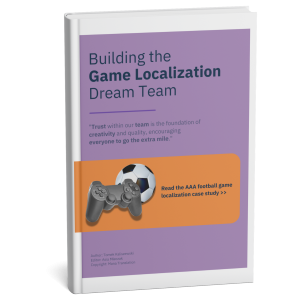
"Trust within our team is the foundation of creativity and quality – encouraging everyone to go the extra mile."
What it built
A team that doesn't just deliver
What came out of this system wasn't just a reliable delivery – though the AAA client gets this too – it was a team of linguists who fact-check football references, flag source text issues to the dev team, and treat localization as craft.
When we say we create localization that's fun to play with, we mean it. It's something we're able to create with what we're building, deliberately, with each decision.
"We can always count on you with your timely deliveries and proactive help."
Full case study
Get the complete picture
The PDF goes deeper: exact role structure, knowledge base setup, how we handle same-day delivery, and what a feedback loop looks like inside a live localization team.
What's inside:
- Full recruitment process breakdown
- Onboarding call structure and what we cover
- Role division in a live ops project
- Knowledge base and reference material strategy
- How open communication changed our quality metrics
No spam. Unsubscribe anytime. Your email is used only to send the document and occasional updates from Mana Translation.
Keep reading
More from Mana
"Localizing warmth – tone and voice in cozy games"
In cozy games, tone isn't a detail – it's the entire experience. Translation that misses the warmth misses the point. We share how we approached tone, cultural references and character voice for the Polish market.
Coming soon
"How communication shapes localization quality"
What happens when translators and proofreaders can talk to each other openly? When teams can brainstorm together – on every project, in real time?
Coming soon
"How to check localization quality without knowing all the languages"
A practical guide for publishers who need to evaluate localization quality without speaking the target languages themselves.
Coming soon